4-Minute Read
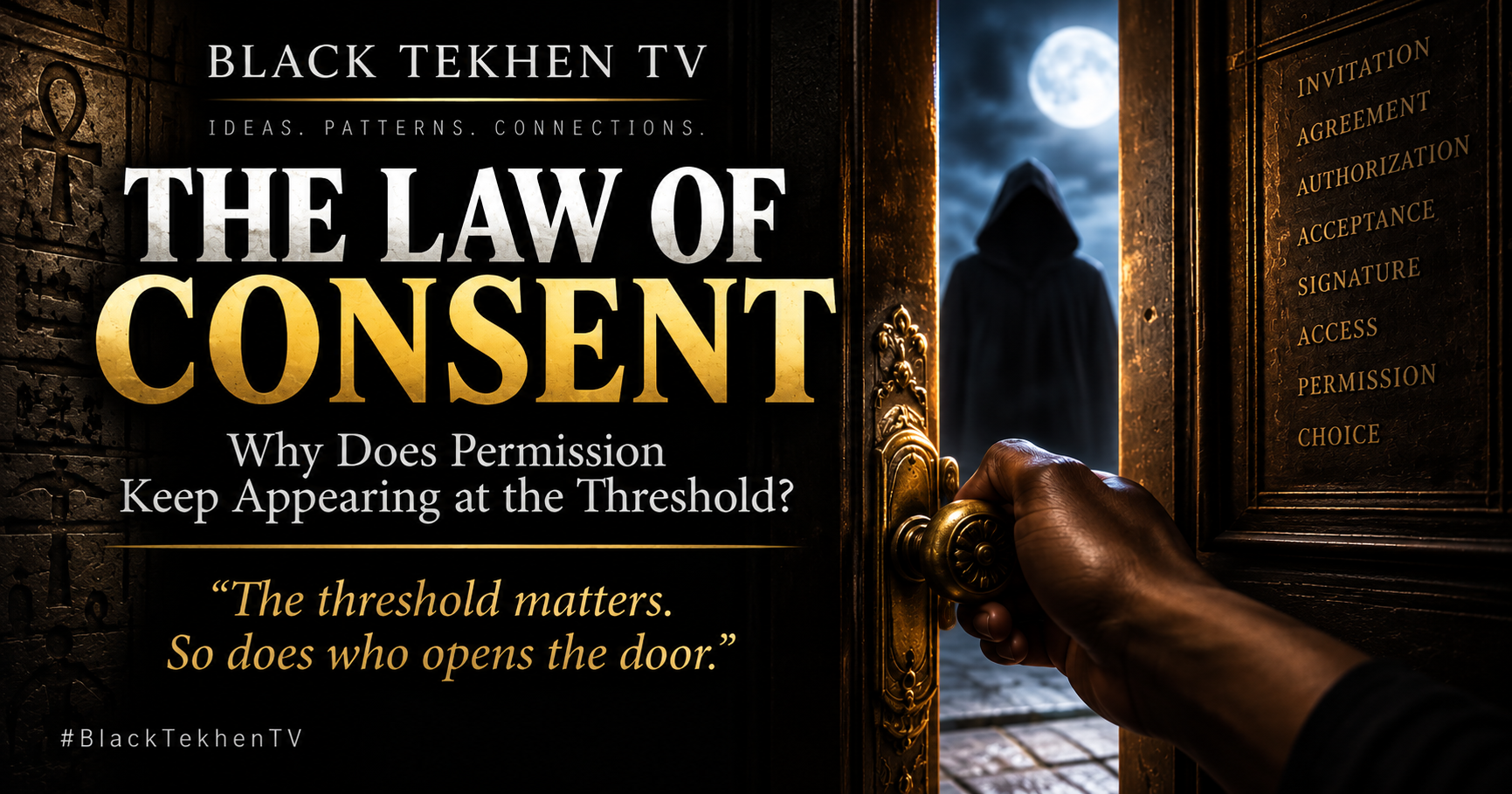
“The threshold matters. So does who opens the door.”
There is an idea that appears in places that, on the surface, seem to have nothing to do with one another.
Permission.
You see it in agreements. You see it in authorization. You see it in technology. You see it in medicine. You see it in mythology and folklore.
Even vampire stories repeatedly return to one peculiar rule:
The vampire waits at the threshold.
It may approach the house. It may speak to the person inside. It may persuade, deceive, charm, or frighten.
But in many versions of the story, it cannot simply enter.
Someone inside has to invite it in.
It's easy to dismiss that as nothing more than fiction.
Maybe it is.
But Hidden Truths asks a different question:
Why does the idea of permission keep appearing at the boundary between what is outside and what is inside?
A threshold is more than a doorway.
It separates two conditions.
Outside and inside.
Public and private.
Stranger and guest.
Before and after.
Unauthorized and authorized.
And something changes when the person controlling that boundary says:
Yes.
The stranger becomes the guest.
The proposal becomes the agreement.
Access becomes authorized.
What was outside has been permitted to cross the threshold.
That doesn't mean every form of consent operates according to some single hidden law. It means the pattern itself deserves examination.
Think about how often modern life asks us to express agreement.
Sign here.
Check this box.
I agree.
Accept Terms.
Allow Access.
Authorize.
A signature can document agreement. A click can indicate acceptance. Medical treatment may require informed consent. Certain searches can be conducted based on voluntary consent. Businesses request authorization before certain transactions or disclosures.
But here we have to make an important distinction.
There is no universal legal rule that nothing can happen to you without your consent.
Governments exercise lawful authority without obtaining individual agreement. Courts issue judgments. Taxes can be imposed. Certain searches can occur without consent when another legal basis exists. Contracts themselves don't always require a handwritten signature to become enforceable.
So the interesting question isn't whether every action requires permission.
Clearly, it doesn't.
The deeper question is:
Why are there so many circumstances where permission changes what another person or institution is allowed to do?
Now return to the vampire.
Whether we interpret the invitation rule as folklore, storytelling, symbolism, or something deeper, notice what the story places at the center:
The creature doesn't merely cross a physical doorway.
It receives permission.
That transforms the threshold.
And once invited inside, the danger that was previously outside is now within the protected space.
Symbolically, that's powerful.
The monster didn't necessarily destroy the boundary.
The person inside opened it.
Suddenly the vampire story can be read as more than a story about monsters.
It becomes a story about access.
What do you permit into your home?
Your relationships?
Your mind?
Your attention?
Your life?
There is another idea frequently repeated in conspiracy and esoteric discussions:
“They have to show you what they're going to do before they do it.”
Sometimes this is connected to secret societies or the Illuminati. Sometimes people use movies, music videos, ceremonies, advertisements, or public symbolism as supposed examples.
The argument usually goes something like this:
If the action is disclosed symbolically beforehand and people accept or ignore it, some form of consent has supposedly been obtained.
But this is where discernment matters.
The existence of symbolism does not by itself prove the existence of a universal metaphysical rule requiring disclosure.
A movie depicting something before a similar real-world event occurs does not, by itself, establish that the movie was a warning or ritual disclosure.
Those are interpretations that require evidence.
At the same time, dismissing every question simply because someone associates it with a conspiracy theory would violate our method too.
So we examine the claim without automatically believing or rejecting it.
Where did the idea originate?
Which traditions actually taught it?
What did those traditions mean by consent or will?
Did later writers change the teaching?
And what evidence exists beyond people repeating the claim?
That is where investigation begins.
There's another layer.
We often associate consent with signing something.
But agreement can sometimes be communicated through words or conduct, depending on the circumstances.
That raises an uncomfortable but useful question:
How often do we participate in things without thinking about what our participation communicates?
Clicking.
Continuing.
Allowing.
Authorizing.
Entering.
Remaining.
Sometimes those actions have legal significance.
Sometimes they don't.
Sometimes their significance is social or psychological rather than legal.
And sometimes people assign spiritual or metaphysical significance to them.
Those categories shouldn't be confused.
But they can still be examined beside one another.
Now we arrive at the center of the circle.
On one side, consent is undeniably important in many real systems.
On another, many things happen without our consent.
Then we have mythology in which permission determines whether something can cross a boundary.
We have spiritual and philosophical traditions concerned with will and choice.
And we have modern claims that powerful institutions disclose their intentions because some hidden principle requires them to do so.
These things resemble one another.
But resemblance is not proof that they all originate from one universal law.
Perhaps different societies independently discovered something fundamental about human relationships:
Boundaries matter.
Perhaps the symbolism influenced later storytelling.
Perhaps some traditions influenced others.
Perhaps we're seeing different concepts that only appear identical when viewed from a distance.
Or perhaps there is a deeper philosophical principle underneath some of them that deserves further investigation.
We don't have to choose the answer before examining the evidence.
So the next time you encounter the invitation, the signature, the authorization, the disclosure, or the simple words “I agree,” pay attention to the threshold.
Then ask yourself:
What existed outside the boundary before consent was given?
What changed after permission was granted?
And perhaps most importantly:
Who opened the door?
Black Tekhen TV
Hidden Truths
See the pattern. Trace the origin. Follow the echoes. Separate fact from interpretation. Then decide what you see.